Eighteen years at the front of the room has taught me this: knowing yoga and knowing how to teach it are two different things. This book is about the space between the two—and how to cross it.
"The anatomy section alone was worth it. I could recite muscle names but had no idea what to actually do when a student's knee caved in during Warrior II. The Certified to Leader Ladder chapter was the first time anyone explained anatomy as something to use, not memorize. I read a room differently now because I finally understand what I'm looking at."
"It gave me permission to build something with my name on it. I'd been teaching for a decade and still felt weird about the word 'brand,' like wanting visibility meant I'd sold out. The chapter on protecting what you build reframed the whole thing — a brand isn't a costume, it's just what your practice looks like once people can see it. I finally launched the workshop I'd been sitting on for three years."
You drove home from your last class replaying every cue. Did I say too much? Was that transition clumsy? Did anyone notice I lost my place?
The manual from your 200-hour is on a shelf. Hasn't been opened since graduation. There's a fine layer of dust on it now. You've rewritten your bio more times than you'd admit to anyone. You've sat with a blank sequencing page until you talked yourself out of the whole idea.
And underneath it, the sentences. You know your own version:
"It's been so long since my training I feel like I've forgotten everything."
"I don't know enough anatomy to answer a real question."
"Everyone else seems to know what they're doing except me."
"I don't need another certificate. I need someone to help me put the pieces together."
If those landed, you're not alone and there's nothing wrong with you. Hundreds of teachers I've worked with have stood in exactly that spot.
Here's what almost nobody names. You are not short on knowledge. You are standing in the in-between: no longer the student you were, not yet the teacher you can see in your mind. It's a lonely place, because everyone around you assumes the certificate already settled the question.
The belief goes like this: I don't feel ready, therefore I must not know enough yet. So the fix is more. Another training. A weekend workshop. An anatomy intensive with a teacher whose Instagram you admire.
It's a reasonable conclusion. It's also the most expensive wrong turn in this industry.
Because for a while it works. Not the teaching part. The feeling part. You're learning again, and learning feels like progress. Then the training ends and you're standing exactly where you were, thinking the same sentence: okay, now I actually have to teach.
Every hour you spend preparing keeps you in the identity of a student. A student receives. A teacher decides. You cannot practice deciding at your kitchen table, because there's nobody in the room to decide for.
Confidence is the result of teaching, not the prerequisite.
In most 200-hour trainings, the most you ever teach is a Sun Salutation A. Maybe a Sun B if the group is feeling brave. A handful of poses, cued to a room of classmates who already know the sequence and are quietly rooting for you to finish.
Then you graduate. And someone hands you a full room of strangers and an hour to fill.
Trainings teach you about yoga. Poses, philosophy, history. What they rarely teach is how to teach. Presence. Cueing that lands. Reading a room. And underneath all of it sits the quieter gap: real anatomy. Not a slideshow of muscle names memorized for a quiz, but a working feel for what's happening inside a body when it moves. The kind that lets you adapt on the spot instead of hoping nobody asks.
That gap is not a small oversight. It's usually the entire reason a teacher freezes the second a real body walks in that doesn't match her plan.
That's not a flaw in you. It's a hole in the system.
For a long time I thought my story started the day I became a yoga teacher. It didn't. It started in all the small moments when I stood at the front of a room and quietly wondered if I belonged there.
I started teaching at seventeen. By twenty-three I was co-leading a 200-hour training, helping a room full of adults, most of them older than me, become teachers themselves. From the outside it looked like I'd arrived. Inside, I was bracing for the day someone would finally notice I wasn't experienced enough to be standing where I was standing.
So I kept pinning my arrival to a future event. For a while it was AcroYoga. Once I became a proper specialty teacher, that would be the moment it clicked. I got the specialty. I traveled the world, taught at festivals, made real money doing the thing I loved. By every outside measure I had arrived.
The feeling never came.
When I'm older. When I know more anatomy. When I can do every pose. Then I'll be a real teacher. It was always out there somewhere, never the actual person breathing in the actual room.
The shift came in my thirties, and it had nothing to do with another training or another pose. It came the day I admitted the permission I was waiting for was never going to arrive.
I had to decide I already was a teacher, and then teach like it.
That was the day my teaching changed. I stopped trying to earn my place in the room and started serving the people in it.
Two teachers can run the exact same sequence and give you two completely different classes. I've watched it happen for eighteen years. The difference isn't the sequence. It's where the attention goes.
Presence isn't a personality. It's a swap.
You stop asking "How am I doing?" and start asking "What do these people need from me today?"
Picture the same forgotten cue, two ways. The reciter loses her place and the floor tilts, because the script was the only thing holding her up. The reader loses a cue and barely registers it. She looks up, sees a room of people wobbling on one foot, and says, "Nobody's winning any awards here, find a wall, find a friend." The room exhales. Somebody laughs.
When you're reciting, every dropped word is a hole in the floor. When you're reading, a dropped word is nothing.
Lead the people in front of you instead of running a memorized plan.
Four rungs, in order, each one holding your weight before you reach for the next.
"I taught one class a week for two months like you said. I stopped saying 'I did a training.' I say 'I teach' now. That's the whole difference."
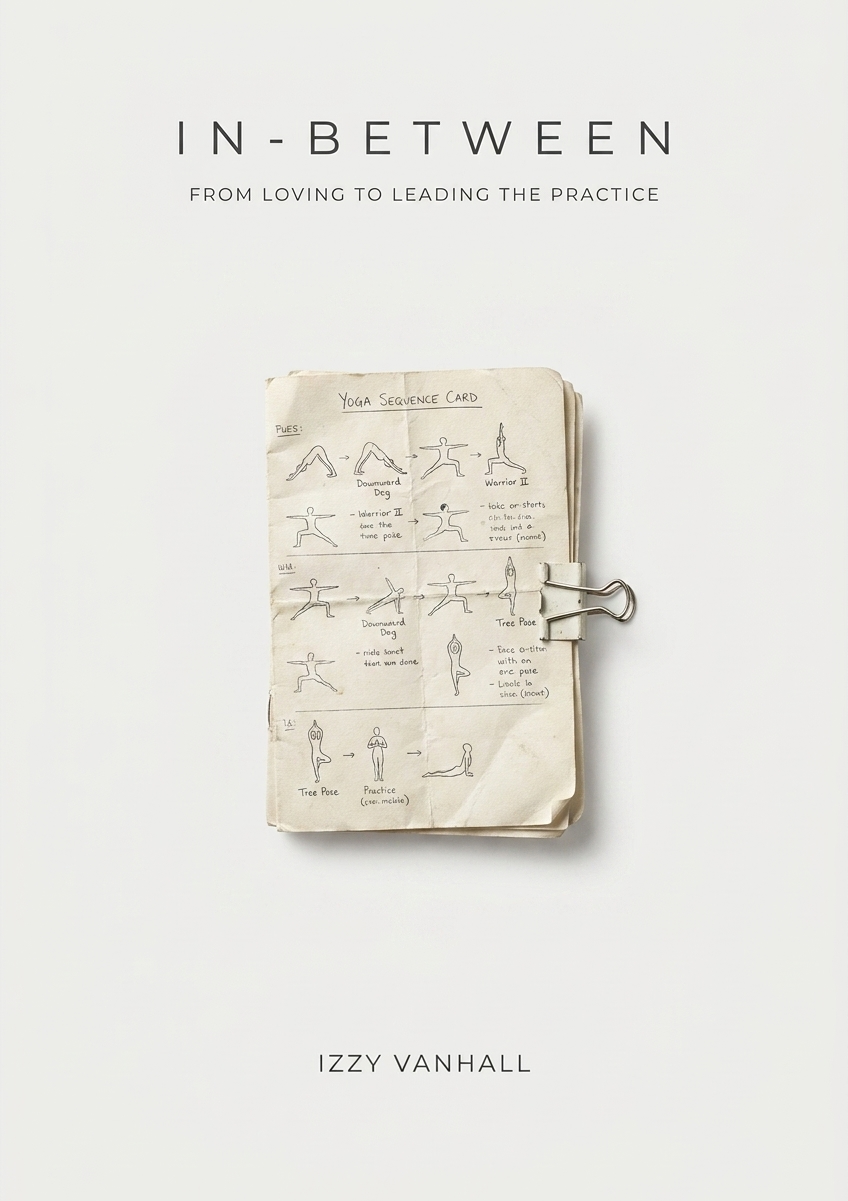
"The Warrior II drawing broke my brain in the best way. I've been teaching a shape for three years. I finally understand what I've been asking people to do."
"I read the chapter on hurdles and my chest went tight at number two. Perfectionism. I've been calling it humility this entire time."
"I was chasing full public rooms because that's what a yoga career was supposed to look like. Izzy asked me what actually lit me up. It was the one-on-one work, and I'd been treating that like failure."
"I got certified and most people would call that the end of the story. Years later I'm still deepening it. My patients feel the difference, and they'll never know why."
Paige took my classes in Boston for years. She's an oncology nurse. She watched friend after friend go through teacher training, and I'd catch the flicker across her face every time. Maybe I could do that.
Eventually she enrolled. She graduated. And then she stopped cold, not because the training was hard, but because actually beginning was. Work was demanding. She'd teach when things settled down. Things never settle down.
What changed wasn't a breakthrough sequence. It was one embarrassingly simple commitment: teach one class a week. One. She stopped waiting for the feeling and started collecting evidence. I stood in front of people. Someone struggled, I noticed, I adjusted, the room was fine, I was fine.
The teaching came first. The identity followed. That line isn't crossed with a certificate. It's crossed one room at a time.
Izzy VanHall has been teaching yoga for over eighteen years, in studios, gyms, corporate rooms, festivals, retreats and teacher trainings around the world. She started teaching at seventeen. By twenty-three she was co-leading a 200-hour training. She's assisted internationally recognized teachers, mentored hundreds of instructors, and graduated well over a hundred teachers through her own trainings.
She spent a decade of that waiting to feel like a real teacher. The permission never came, so she stopped waiting for it.
Her work now is the thing she needed and nobody offered: the part after graduation. Not more information. Reps in front of real people, honest feedback, and anatomy you actually trust when a student asks a question you didn't prepare for.
Picture yourself walking into a room and your stomach doesn't drop. A body shows up that can't do the pose you wrote down, and you have somewhere real to go. You lose your place and it costs you nothing, because you were reading, not reciting.
Someone rolls up their mat, walks over, and says the five words: I never thought I could do that.
That teacher isn't a different kind of person than you. She's you, a certain number of reps from here.
That line isn't crossed with a certificate. It's crossed one room at a time.